
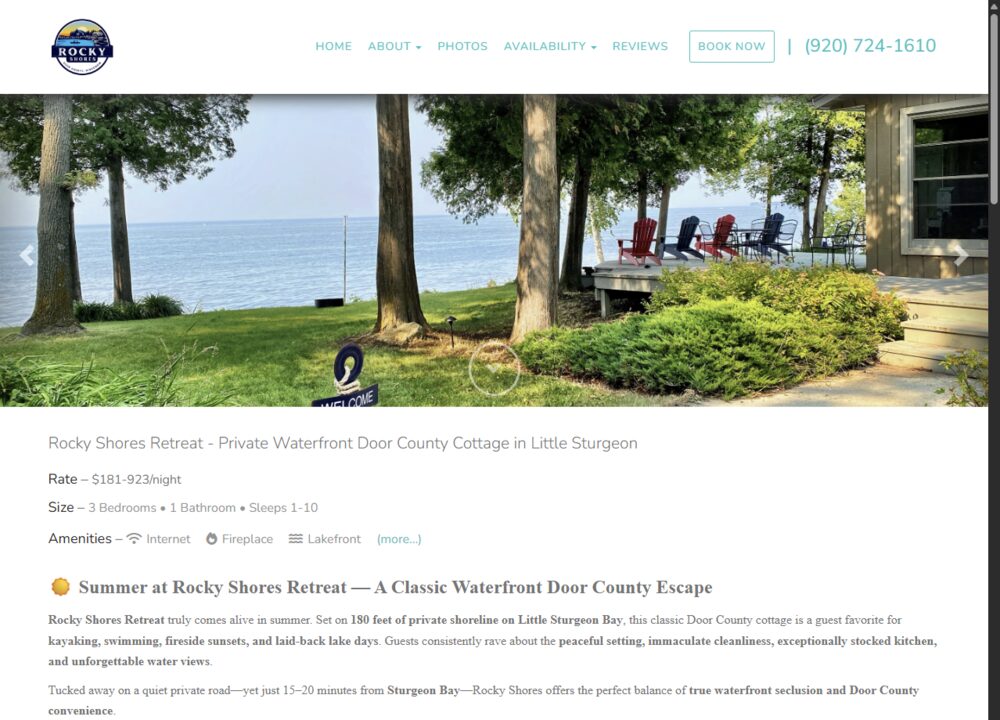
Rocky Shores Retreat
Ledge rock, open water, big sunsets. Its own site, its own returning guests. rockyshoresretreat.com
Your cottage is not a unit in someone's portfolio. It is a market of one, and it should be run like one.
In January 1989, Richard Winger and David Edelman published Segment-of-One Marketing at BCG. Their claim was operational rather than promotional: segment-of-one brings together two formerly independent things — information retrieval and service delivery — so that individualised service can be produced at mass-production economics.
That maps precisely onto a short-term rental book. Individual attention isn't scarce because people don't care. It's scarce because it's improvised, and improvisation collapses under volume.
Individual attention only becomes economical once it stops being improvised.
Which is why the Property of One is not a promise about effort. It's a claim about method.
| Decision | Portfolio manager | Baylake |
|---|---|---|
| Pricing | One rule set applied across the book, adjusted seasonally | A comp set built for your home, reviewed weekly |
| Listing | House style, so the portfolio reads consistently | Its own voice, so it competes as an individual property |
| Brand | The management company's brand carries the booking | Your property owns its own name, site and audience |
| Maintenance | Reactive; a vendor is dispatched when a guest reports it | Scheduled inspection, so the guest never reports it |
| Guest | Belongs to the platform or the manager | Belongs to your property, and returns to it |
| Scale limit | More properties improve the economics | More properties threaten the promise, so the book is capped |
Ledge rock, open water, big sunsets. Its own site, its own returning guests. rockyshoresretreat.com
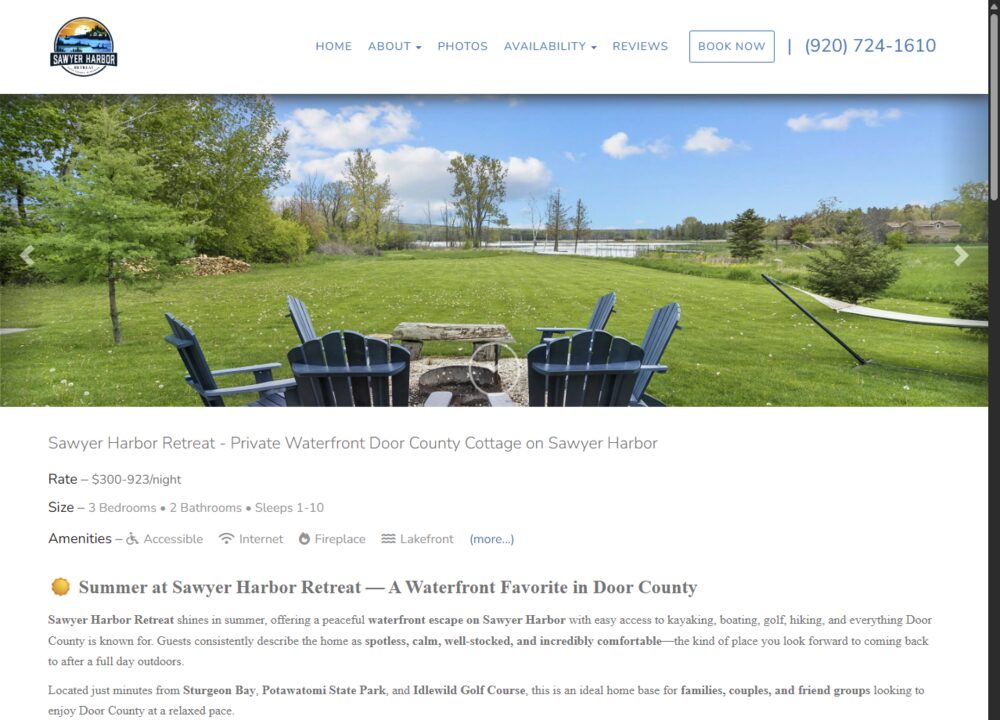
Sheltered bay, dock, lawn to the water. A different guest entirely. sawyerharborretreat.com
Read the difference, not the quality. Two homes run by one company should not sound like the same house — and if they do, you're being managed as a portfolio.
Its own domain, its own direct bookings, its own repeat guests — assets that stay with the property if you ever leave us.
Guests come back to the cottage, not to a management brand they'll never think about again.
What we built for ourselves is what gets built for your home. Not a template with your photos dropped in.
Every manager says they'll treat your property like their own. The claim is untestable, so it's worthless — and it's also, in the literal sense, impossible. Owner attention is finite. It does not survive a fourth property or a July Saturday with three turnovers.
So we concede it. The standard comes from having owned and run these homes ourselves for fifteen years. The scale comes from having written that standard down — playbooks, a 200-point inspection, a weekly pricing review — so it executes without depending on how anyone feels on a given Saturday.